# Newton's Villages: How Do You Choose the Right Neighborhood?
Key Takeaways
•The short answer: When comparing Newton MA neighborhoods this fall, check the zoning map before the school map — per Boston Indicators researcher Amy Dain, Newton's Village Center Overlay District (VCOD) already sorted the villages into places where added units are allowed without a special vote and places left essentially untouched.
•The myth: "Newton got rezoned" is one fact that applies everywhere.
•The reality: Per Dain's Boston Indicators analysis, the Multi-Residence Transit (MRT) district — where added units are allowed without a special permit — covers less than 2 percent of Newton's land area.
•The bottom line: Pull the parcel-level Newton zoning map for any address, and confirm current rules with your agent, before you write an offer.
Most buyers start with schools, commute, and curb appeal. Fair enough — those still matter. But there's another question worth asking early:
Is this block legally likely to change?
Amy Dain's Boston Indicators report was presented in West Newton, followed by a parcel-level breakdown. This is the first full fall market where buyers can actually use that overlay map as a neighborhood-selection tool.
Where Did Newton's Zoning Actually Change?
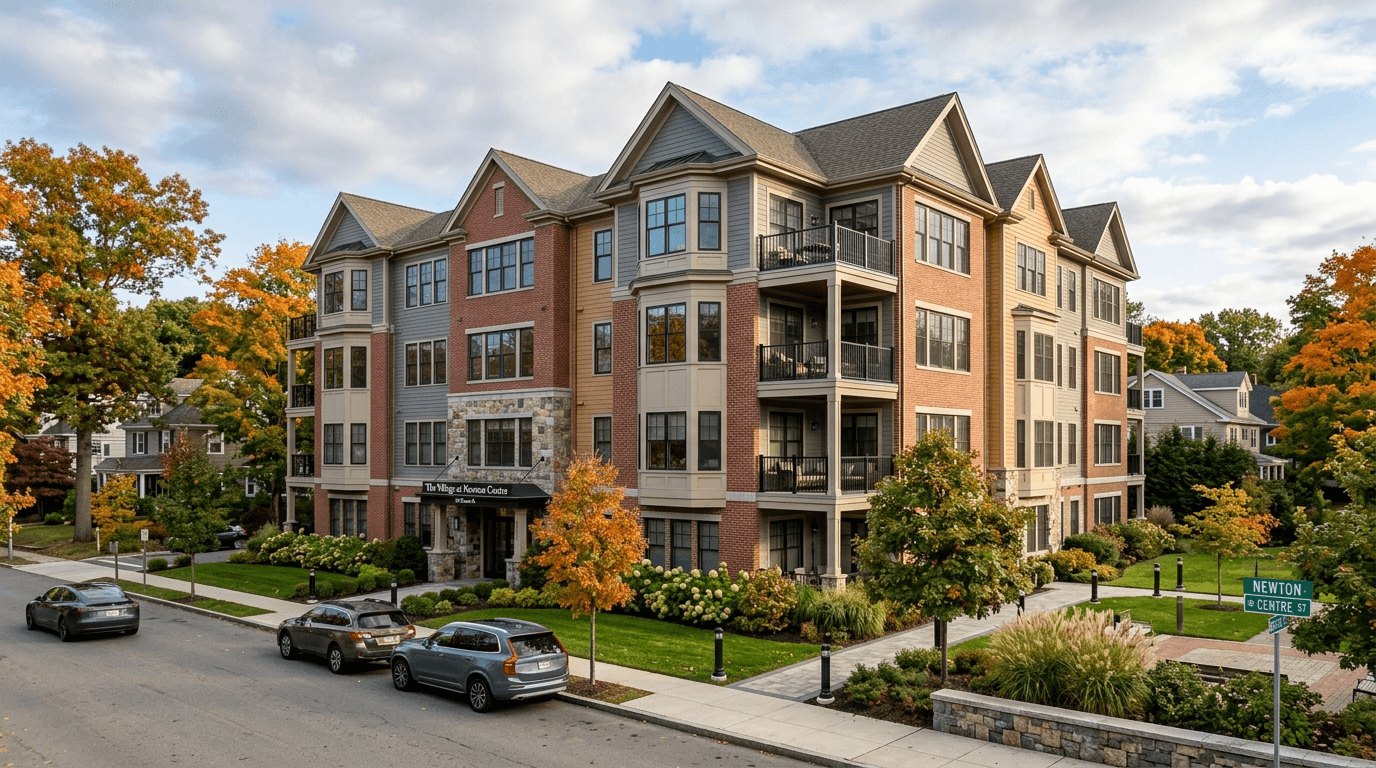
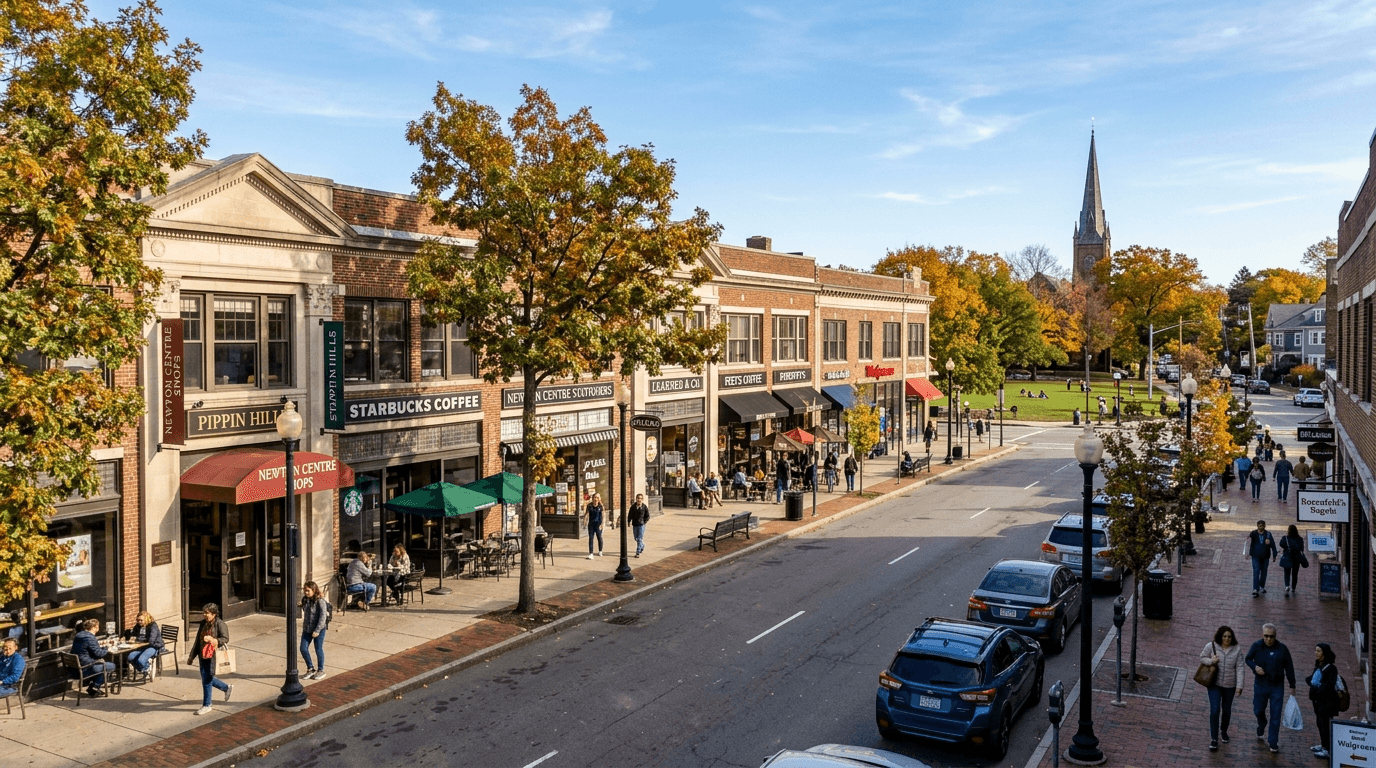
Per Dain's analysis, the biggest practical shift runs from Newton Centre to Newton Highlands. That stretch along Centre Street links two T stops and forms the connected multifamily corridor inside the MRT district.
Inside that district, fourplexes are allowed as of right — no special City Council vote required. Confirm what any specific lot allows with your agent. Often the original house stays put and units get added inside it, softening the visual impact on the street.
Best fit: buyers who want walkability, shops, and transit, and who are comfortable with gradual change.
More rental neighbors, and more pressure on street parking over time — that energy reads as a plus for some buyers and a daily headache for others.
The pace, though, is slow. Dain counted about 15 small and medium projects citywide, most preserving existing homes, adding up to fewer than 100 net new units. This isn't overnight transformation. It's a door that stays open: once a lot earns the right to add units, it keeps that right.
Which Villages Were Mostly Left Alone?
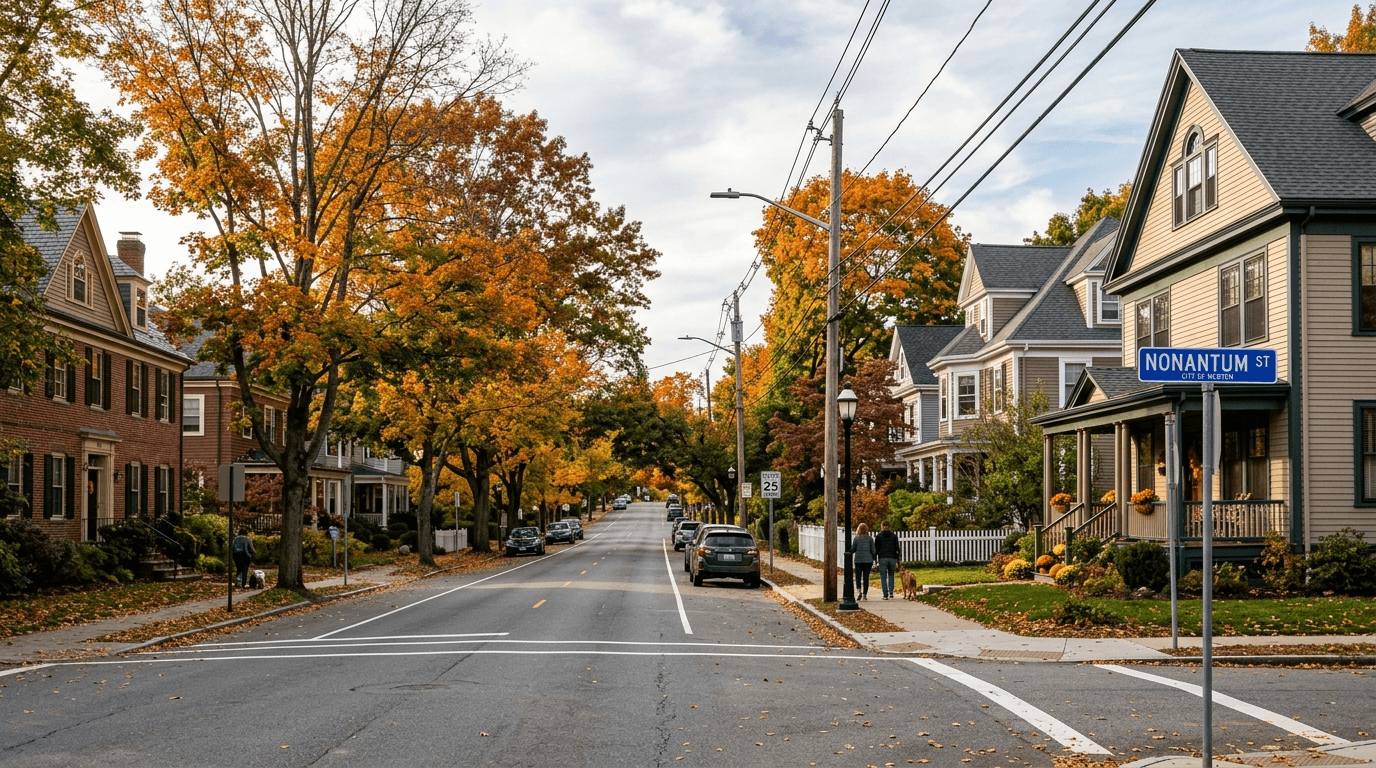
For more stability, look at Chestnut Hill, Waban, Auburndale, and Nonantum — each excluded for a different reason, per Dain's parcel-level breakdown.
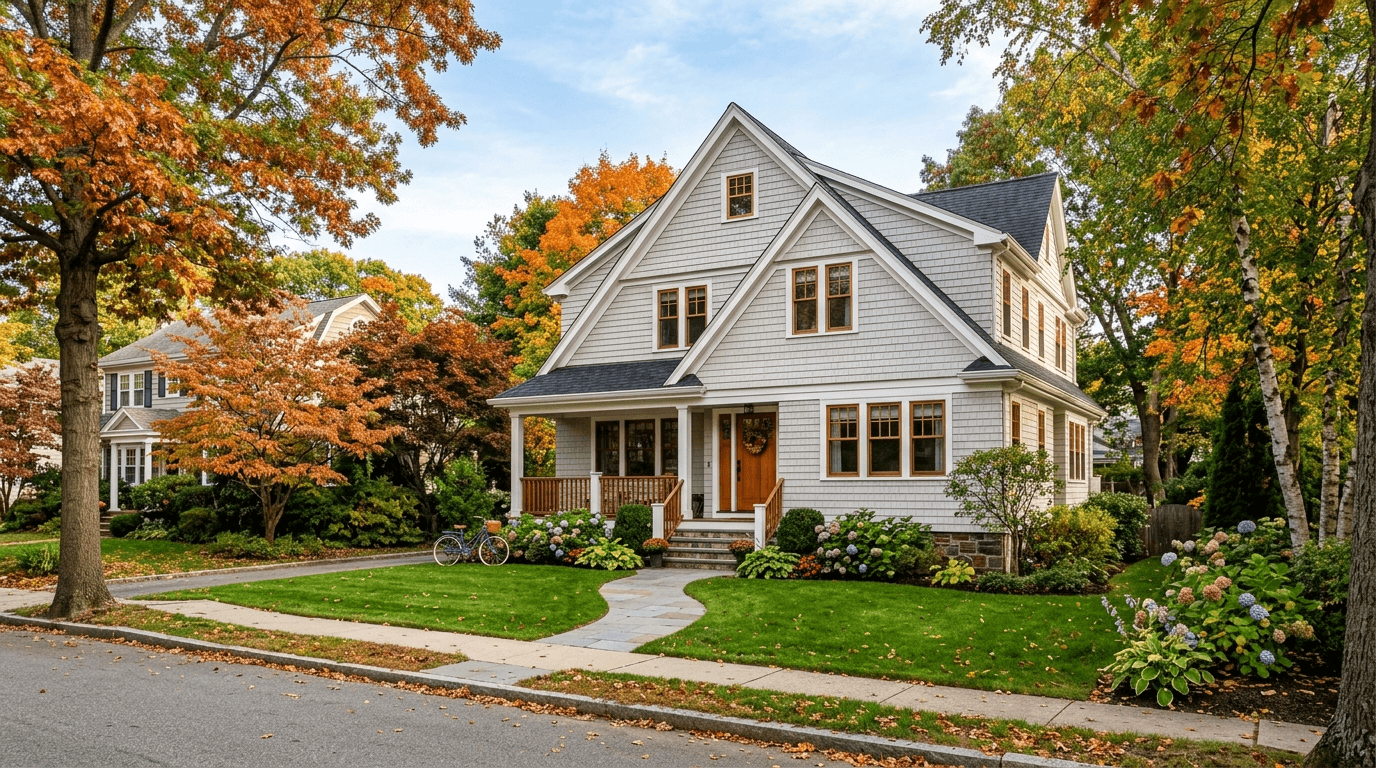
Chestnut Hill and Waban sit at the top of Newton's market. Chestnut Hill was largely excluded because it's ringed by historic district land and institutional land, neither of which folds easily into a multifamily zone.
Auburndale's exclusion was technical. The state requires one connected block of land above a minimum size, and Auburndale couldn't assemble enough of it. Streets required to have ground-floor retail didn't count toward that total.
Nonantum is the paradox here. It's Newton's most densely populated village, full of exactly the housing type the MBTA Communities Act aims to create — yet Dain's breakdown shows it was left off the overlay entirely.
Exclusion isn't a discount signal, though. Waban's typical single-family range runs $2M–$3M+, per the 2026 Newton school-zone and home-value guide, while Nonantum — also excluded — runs $1.1M–$1.5M. Being off the overlay map tells you about future change, not about price.
Typical Single-Family Price Ranges by Newton Area
Neighborhood and school-zone-driven single-family price bands across several Newton areas.
| Series | Label | Value |
|---|---|---|
| Typical single-family price range | Waban | $2M–$3M+ |
| Typical single-family price range | Newton Centre / Mason-Rice | $1.7M–$2.5M |
| Typical single-family price range | West Newton (Bowen → Day → Newton North) | $1.3M–$1.9M |
| Typical single-family price range | Nonantum / Newton Corner | $1.1M–$1.5M |
Are West Newton and Newtonville Better Value Plays?
Often, yes — with a tradeoff.
West Newton received village-center zoning (VC1, VC2, and VC3), but only after a political fight that limited how much density the final map allows. The map is a political compromise, not just a planning document.
And the overlay isn't the whole story. Dain's analysis points to large projects moving through Newton's older special-permit process outside the VCOD, including Northland, Riverside, and West Newton's Newton Crossing. A village can look stable on the zoning map and still get reshaped by one large project nearby.
Pro tip: ask the city for its special-permit pipeline, not just the zoning color.
For families balancing price and schools, West Newton can be compelling. It typically runs $1.3M–$1.9M for a single-family home — a real discount to Waban, with Newton's district-wide academic strength intact. Newton students hit 71% math proficiency, compared with the Massachusetts average of 43%, per the Steinmetz Real Estate Pros 2026 schools guide.
Newton School Proficiency vs. Massachusetts Averages
Comparison of Newton Public Schools district proficiency rates with cited Massachusetts state averages in math and reading.
Newton district
Massachusetts average
| Series | Label | Value |
|---|---|---|
| Newton district | Math proficiency | 71% |
| Massachusetts average | Math proficiency | 43% |
| Newton district | Reading proficiency | 68% |
| Massachusetts average | Reading proficiency | 45% |
What Should You Check Before Writing an Offer This Fall?
Run three checks from Dain's parcel-level analysis, and confirm each with the city or your agent:
•Is the lot inside the actual connected corridor? Being in a village with some MRT streets isn't the same as being on one.
•Is the lot outside every historic district line? Historic parcels get excluded no matter what the broader map suggests.
•Does the lot front a street required to have ground-floor retail? That can disqualify it from the multifamily overlay.
Two live policy issues deserve a question to your agent. First, ask whether state rules on accessory dwelling units — small second homes on the same lot — now allow one next door, even on a "stable" lot. Second, ask whether any pending state bill would let two-family homes be built where only single-family homes stand today.
Don't skip your inspection, either. Ask your agent whether Massachusetts currently restricts sellers from requiring inspection waivers, and whether any exemptions apply to your deal. In a city full of century-old houses, that protection matters.
You have room to use it. Newton homes sit an average of 86 days on the market — slow enough to give a careful buyer time. But sellers still collect 99.8% of asking, the sale-to-list ratio that shows just how much of that number actually holds.
Newton Housing Market Snapshot
Headline market metrics for Newton, MA, combining price, supply, pace, and negotiation context in one snapshot.
Current Market
Median list price$1.9M
Active listings290
Days on market86 days
Sale-to-list price ratio99.8%
Inspect carefully — but don't expect an aggressive lowball to work.
What Are the Best Arguments Against Using the Zoning Map This Way?
If fewer than 100 units have been added, does this matter? Yes, because the right to build is the change itself. Dain's count of fewer than 100 net new units is a fraction of what the overlay enables — a timing signal, not proof the map is irrelevant. That right in the MRT district is permanent: change is deferred, not cancelled.
Could excluded villages be added later? Fair concern. Auburndale's exclusion rests on an acreage technicality, and West Newton's density limits came out of a political fight. Neither is guaranteed forever, and Newton's obligation under the MBTA Communities Act doesn't disappear. Treat today's exclusions as current conditions, not permanent promises.
Isn't treating new housing as a risk exactly how Massachusetts got this expensive? Honestly, yes. Decades of blocking homes is a big reason a single-family home in West Newton starts near $1.3M and Waban runs past $3M. Dain calls the reform "a huge accomplishment," and that's fair. But reading the map is a fit-and-timing tool, not an anti-housing one. Some buyers should want the MRT district — the same by-right rules that let a neighbor add units let you add them on your own lot. The real question is whether the block you buy matches the future you expect.
So Which Newton Are You Really Buying?
There's no single best Newton village. There are two Newtons: a stable single-family Newton where the rules barely changed, and a narrow set of corridors where the math genuinely changed, even if the street still looks familiar.
Dain's line captures it best: "Small-scale projects have to happen on a lot of parcels to add up." Her breakdown shows they can't happen everywhere in Newton. That's why exclusion reads as stability today — and why the next big shift may come from the State House.
Before you make an offer, pull three documents for the exact address:
1. The parcel-level overlay map
2. The historic district boundaries
3. The special-permit pipeline nearby
Want help comparing two or three Newton villages block by block? Send us the addresses, and we'll show you which Newton you're actually buying.